
Judging by how things are going, the market is not in a World Cup mood. For the third consecutive month, the fat ox showed a decline according to the CEPEA/B3 indicator, closing below 300 reais in the monthly average, a fact that only occurred in October 2021 with the market crisis due to the BSE, mad cow disease, case.
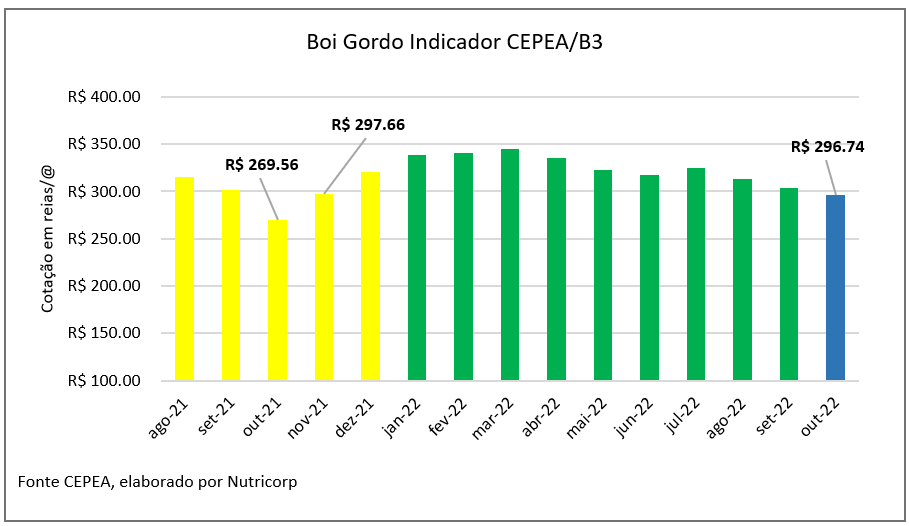
Looking at the chart above, it’s relatively easy to see a downward trend in prices since March 2022, when fat cattle were priced at around 350 reais per head. The main driver of this downward trend is the Brazilian economy, which has not been doing particularly well. The unstable economic climate has led many Brazilians to cut beef from their diets, opting instead for cheaper protein sources such as pork and poultry. In stark contrast to the domestic market, exports remained strong in 2022. Data released by the Foreign Trade Secretariat (SECEX) show that, through October 2022, Brazil exported 1,690,000 metric tons—a volume 25% higher than that from January through October 2021.
On the supply side, the livestock sector continues to show strong growth, increasing the supply of animals, especially during this off-season period. According to data released by Scot Consultoria, the estimated number of feedlot cattle in Brazil for this year is 5.18 million head, representing a 5.07% increase compared to the previous year.
Moving to the shopping side, corn showed a completely opposite movement to that of fat cattle.
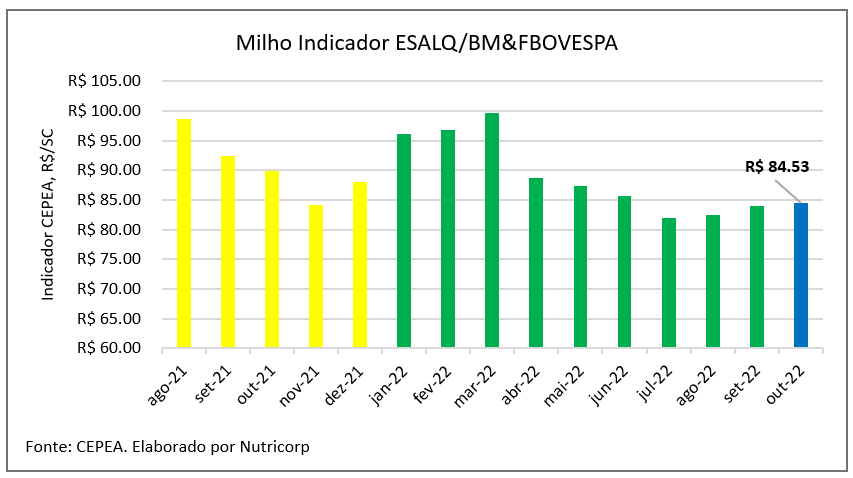
The grain ended October with a 0.56% increase compared to September. The main news of the month was the authorization of corn exports to China, when the government announced that 136 facilities had been cleared to ship the commodity to the Asian country. This new option for marketing the grain has brought a great deal of uncertainty to the market, particularly regarding the amount of production that will remain in the country for cattle feed and what its future price will be. What we can be certain of is that, now more than ever, cattle producers will need to pay close attention to their production planning and management practices.
Despite all this pressure, the feedlot daily cost indicator published by the Laboratory of Socioeconomic Analysis and Animal Science (LAE) showed a decline in the month of October.
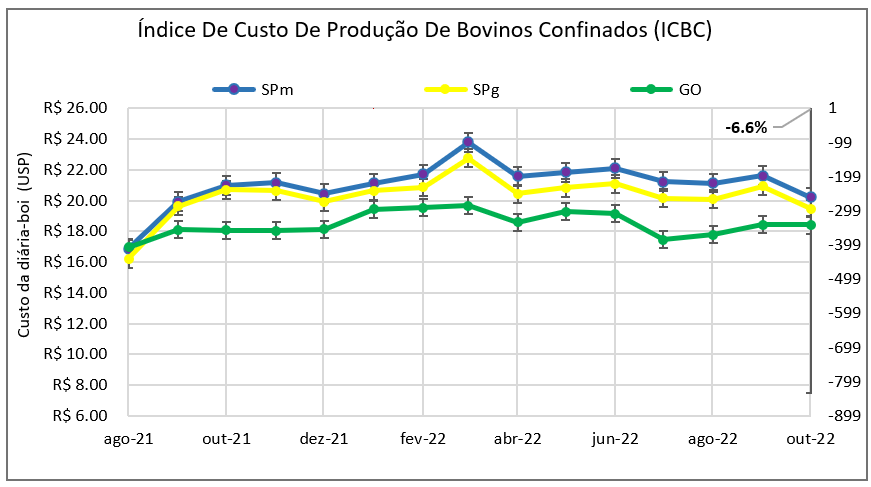
Large-scale feedlots in São Paulo (SPg) and medium-scale feedlots (SPm) saw declines of 6.91 TP3T and 6.71 TP3T, respectively, while Goiás saw a decline of 0.11 TP3T. For producers in São Paulo, the main reason for the decline was the drop in the price of sorghum, while for those in Goiás, soybean meal was the primary factor.